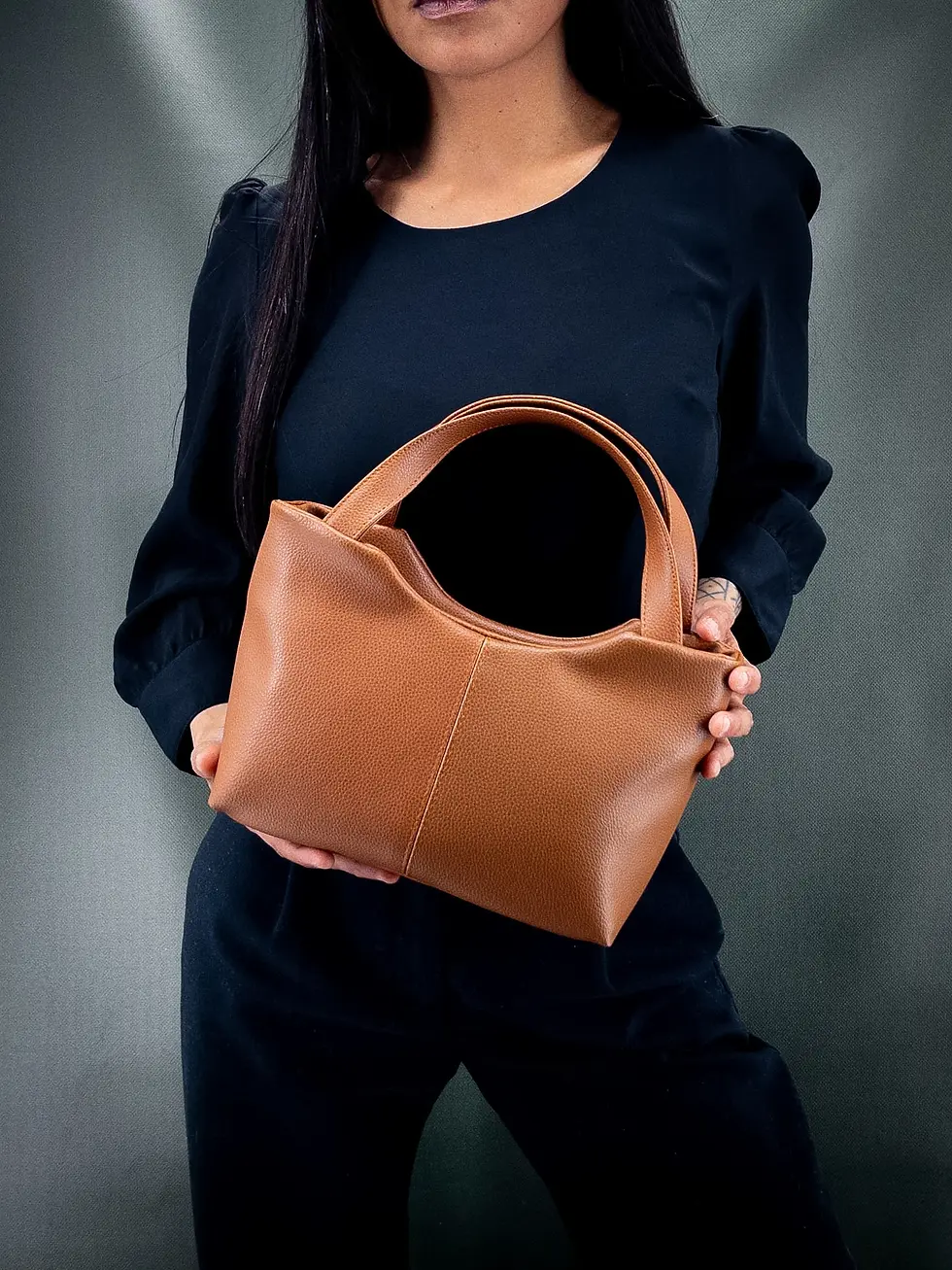
How to Choose a Vegan Work Bag: 5 Questions to Ask
Updated: Sep 3

A work bag does not necessarily need to be a laptop bag. And choosing the largest format is not automatically the most practical option.
The right choice depends on what you actually carry, how you move through your day and how much structure you need.
Before choosing a bag, five questions can help define what really matters.
1. What do you actually carry every day?
Start with the contents rather than the bag.
A wallet, phone, notebook, water bottle and a few personal items require a different amount of space from a laptop, charger, documents and work accessories.
A larger bag is not automatically more useful. If much of its volume remains unused, it can make the contents harder to organise and add unnecessary bulk to your daily carry.
Instead of asking “What size work bag should I buy?”, start with:
“What do I actually carry on a typical day?”
Once you know that, the required size becomes much easier to determine.

2. Do you actually need to carry a laptop?
A work bag and a laptop bag do not serve exactly the same purpose.
If you do not carry a laptop, volume, access, interior organisation and carrying options may matter more than a dedicated computer compartment.
If you do carry one every day, the laptop's actual dimensions, the design of the compartment and the space needed for its charger and accessories become important.
One detail is easy to overlook: a laptop's screen size is not the same as its external dimensions. A 14-inch or 16-inch label refers to the screen diagonal. Two laptops with the same screen size can have different physical dimensions.
For a laptop bag, compare the actual dimensions of the computer with the dimensions of the compartment whenever these are available.
At Lubay, two approaches meet this need. Alna has a large main compartment with room for a laptop and A4 documents; its large flat interior pocket has been tested with a 13-inch MacBook Air. Ieper Laptop takes a different approach: its length and height are defined according to the dimensions of the laptop or laptop sleeve.

3. What kind of structure suits the way you use your bag?
Structure affects how a bag holds its shape, how it opens and how its contents are organised.
A clearly structured bag can be useful when you regularly carry documents, a laptop or other items that benefit from a defined interior.
Other designs leave more room for the contents themselves and for the way the bag is carried.
There is no single structure that works for every work routine.
What matters is how the bag behaves when it is actually being used, not only how it looks when empty.
At Lubay, structure is part of the design of each model. Proportions, volume, opening and carrying options are considered together.
4. How will you carry the bag?
The way a bag is carried becomes particularly relevant when it is used for several hours a day.
Shoulder carry keeps the bag close to the body and works naturally for everyday movement.
Crossbody carry leaves both hands free and can be useful when walking, commuting or moving between different places during the day.
Hand carry changes the way the bag is handled and can suit formats with a more defined structure.
If your routine changes throughout the day, a removable and adjustable strap can allow you to switch carrying options without changing bags.
The most useful option is therefore the one that corresponds to how you actually move.

5. What does “vegan” tell you about a bag?
The term 'vegan' indicates that a product contains no components of animal origin. It does not just describe the main material, but applies to all other parts of the bag as well. For instance, if glue is used, it will also be entirely free of any animal-derived ingredients.
When it comes to materials, vegan bags can be crafted from a wide variety of sources. To fully understand what you are buying, it is helpful to look closely at the material's name, origin, and specific characteristics.
Lubay exclusively uses next-gen vegan materials without animal components, selected within the European Union. Leap® and Grape Skin® are among them.
Leap® is developed in Europe from residues of apple processing and manufactured in Germany. Grape Skin® is developed and made in Italy from residues of wine production. They have different characteristics and are not presented as a hierarchy.
The material is therefore one criterion among several: format, structure and carrying options matter just as much.
In short
Before choosing a vegan work bag, consider:
What do I actually carry?
Do I need to carry a laptop?
What structure suits my routine?
How will I carry the bag?
What material is used?
There is no universal work-bag format.
The ideal choice is the one whose volume, structure and carrying options correspond to your actual day.
FAQ
Does a work bag have to be a laptop bag?
No. A work bag can simply be designed to carry everyday work essentials without a dedicated laptop compartment.
How do I choose the right size work bag?
Start with what you actually carry each day. A laptop, charger and documents require more space than a notebook, water bottle and a few personal items.
How do I know if my laptop will fit in a bag?
Compare the physical dimensions of your laptop with the dimensions of the laptop compartment. Screen size in inches refers to the display diagonal and does not give the laptop's full external dimensions.
Does a work bag need to be structured?
Not necessarily. Structure can help maintain the shape of a bag and organise its contents, but the right construction depends on how the bag is used.
What should I look for in a vegan work bag material?
Look at the material name, origin and characteristics rather than relying on the word “vegan” alone. Lubay uses next-gen vegan materials without animal components, selected within the European Union.